
Significant Project Features:
• In-Situ Solidification (ISS) by method of bucket mixing, with a 16% addition rate of Type I/II Portland Cement to solidify/stabilize the contaminated soils.
• 19,550 CY of contaminated soils were remediated.
• Areas with higher concentrations on coal tar were mixed with the Allu Rotary Tool.
Project Background:
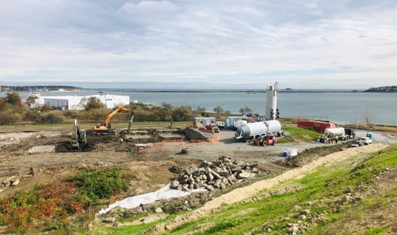
This remediation project is a disposal site associated with a former manufactured gas plant along Riley Way in Lynn, MA. The environmental investigation work was completed by Innovative Engineering Solutions, Inc. (IESI) on behalf of Massachusetts Electric Company and National Grid. The former MGP site, defined by the Massachusetts Department of Environmental Protection, contained contaminants such as coal tar and other MGP-related compounds in the exclusion area. IESI determined that in-situ soil stabilization would effectively treat and remediate the effected soils. The site is adjacent to the Lynn Harbor, and is surrounded by several commercial and industrial properties such as the Lynn Municipal Sewage Treatment Plant.
Description of Work:
GSI utilized the ISS method of excavator mixing, or bucket mixing, to successfully solidify the contaminated soils as well as prevent future water contamination. Two John Deere 300 excavators were utilized in the ISS mixing. However, for soils in the southern portion of Area 1, GSI was required to use a rotary tool attachment on an excavator to ensure proper mixing due to higher concentrations of taffy-like coal tar. GSI used the Allu Rotary attachment on a Case CX3500 excavator.
ISS mixing was broken down into multiple areas, A through Q. Cells in areas A, I, and P had dimensions of 5’ wide by 10’ long due to stability concerns with the proximity of the road. A primary secondary technique was utilized for this portion of mixing. The remaining cells had dimensions of 10’ wide by 10’ long. Each area required different depths that were determined by the client’s subsurface exploratory logs. Based off of the areas concentrations of contaminants, a certain depth was determined suitable for ISS mixing.
GSI utilized a batch plant setup to produce a grout consisting of Type I/II Portland cement and water that was pumped to the treatment areas. Samples were taken frequently at the batch plant and the mixed cells to ensure quality assurance. The grout was required to be around 101-102 pcf with a viscosity ranging from 31-33 sec. Casted samples of the cells were stored properly on site until ready to be shipped to a testing laboratory. The required specifications of the samples had to be no less than 200 psi.
ISS by Bucket Mixing
• 7000.5 cubic yards (northern area)
• Depths ranging from 10 – 11 feet
ISS by Rotary Mixing
• 12552.5 cubic yards (southern area)
• Depths ranging from 2 – 13.1 feet.
Key Project Objectives:
• Ensure a target strength (200 psi) at a minimum of every 250 CY mixed.
• Ensure target depths were being met with the Topcon Total Station.
• Confirm that the required grout parameters were being met through mud balance and marsh funnel tests.
Project Challenges:
• A limited amount of Portland Cement trucks (8) that could be delivered each day forced GSI to not utilize the full 10-12 hour work day.
• Encountered taffy-like substance in the high coal tar areas which required additional mixing efforts