
Significant Project Features:
- Installation of 1,850 linear feet of sand filter trench using the bio-polymer slurry trench method
- Use of guar gum for slurry creation
- Pre-Excavation of rockfill using Cement-Bentonite self-hardening slurry
Description of Work:
Geo-Solutions, Inc. (GSI) was contracted for the installation of a sand filter trench at the toe of Fresno Dam near Havre in Hill County, Montana. The sand filter trench was designed to filter the seepage of water that has been occurring through the dam. The filter trench will ultimately become part of the chimney drain in future phases of the dam rehabilitation.
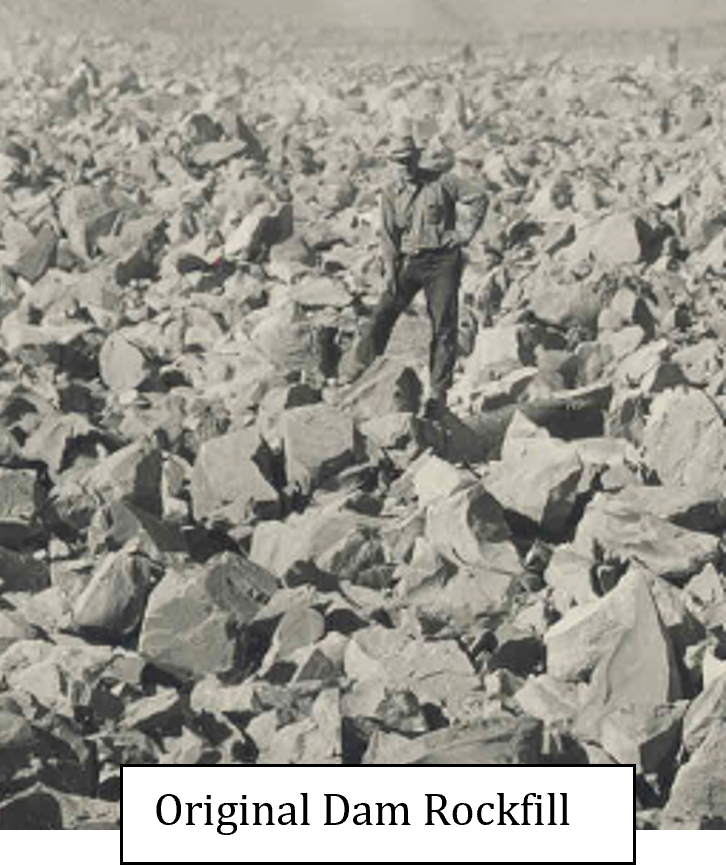
During construction of the dam in the 1930s, a large quantity of rockfill was used at the downstream toe of the dam. GSI elected to remove this rockfill in a pre-excavation phase as part of its means and methods. The general fill and rockfill was 20 feet thick, and is scheduled to be removed in future phases of the dam rehabilitation. However, due to the overall earthwork and dewatering phasing, the sand filter needed to be installed through this rockfill layer plus an additional 20 feet into the underlying alluvium.
To achieve the pre-excavation, GSI installed a self-hardening slurry trench over the full 1,850-foot-long alignment prior to installing the filter. The cement-bentonite slurry trench was 66” wide to effectively become a “guide-wall” for the bio-polymer trenching. The slurry was allowed to gain enough strength to maintain its integrity prior to trenching though it.
The project specifications required the use of bio-polymer slurry for the installation of the filter trench. GSI elected to use guar-gum based polymers for slurry creation. The trench is 1,850 feet long with a fixed design depth of 40 feet from the working platform. The upper 20 feet of this part of the dam, including the cured CB slurry, the rockfill, and the upper “sacrificial” part of the sand filter will ultimately be removed in future phases of the dam rehabilitation.
The trench backfill required is sand (fine aggregate) meeting a specified gradation for filtering. The sand was produced and supplied by a local commercial gravel pit. It was placed by hauling the sand to the side of the trench using front-end loaders. The sand was initially introduced into the trench on a “lead-in” slope excavated beyond the end of the alignment. Once the sand reached an angle of repose under the slurry, and “daylighted” at the work platform, it continued to be added at the surface, which advanced the entire leading face of the sand backfill down the alignment of the trench. Project specifications required the sand to be placed from the bottom up, using a tremie or similar method. The USBR engineers accepted the lead-in placement method as conforming to the “bottom up” requirement.
After the trench was completely backfilled, temporary 6” wells were placed in the trench to facilitate slurry “break” and trench development. The wells were installed using a sonic drill rig, and had a fine 10-foot-long screen section at the bottom. The initial fluid pumped from the wells indicated that the bio-polymer slurry had broken naturally. To ensure all slurry was fully broken, LEB-H enzyme breaker was poured into the wells and circulated with the use of electric submersible pumps.
The quality control for construction included testing of the properties of the slurry, sampling of the sand material, and laboratory grain-size testing of the sand backfill.