
Background
In 2021, Syncrude Canada Ltd (Syncrude) was constructing a new tailings dam at the South In-Pit Pond at its North Mine near Fort McMurray, Alberta. The mine is located approximately 40 km north of Fort McMurray, Alberta. The proposed COW was constructed to address potential fractures and seepage pathways through the underlying McMurray Formation.
Project Objectives
Geo-Solutions, Inc. (GSI) was contracted by North American Construction Group to install the self-hardening cutoff wall along the alignment of the South East Closure Dam, also known as the Octopus Dam. The COW is required to minimize the seepage of process affected water (PAW) beneath the Octopus Dam. The cutoff wall was installed from an earthen platform that is the foundation of the future earthen dam. The project had a completion deadline of July 2021 in order to maintain ongoing mining activities.
Description of Work
The cutoff wall included the installation of 1,200 vsm (12,910 sq. ft.) of SCCB slurry wall. The wall was installed to a maximum depth of 15 meters (49 feet) below ground surface. Typical depths were in the range of 14-15 meters (46-49 feet). The depth of the wall was deigned to cutoff the siltstone and McMurray layers that were identified to have the potential for hydraulic fracturing and seepage, and to key the cutoff wall into the competent underlying McMurray formation that had no fractures.
The cutoff walls target laboratory permeability of 1 x 10⁻⁷ cm/s was exceeded at 56 days. The strength of the cured SCCB slurry averaged >1.5 MPa (200 psi) at 56 days. The strength of the wall was required to withstand loading of mining haul trucks that will operate in this area in the future, which fully loaded weigh 615 tonnes (680 us short tons).
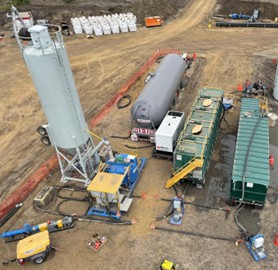
The excavation was supported by the liquid SCCB slurry and performed using a CAT 390 excavator with GSI’s long-reach stick attachment. The slurry was produced on site with our custom continuous-mix batch plant. Slurry was pre-mixed and hydrated in a frac tank. The bentonite slurry was then pumped into the mix plant where slag and cement powder were added from bulk pneumatic silos. The slurry was then pumped to the trench location.
Prior to excavating the cutoff wall trench, GSI competed pre-drilling of areas of the alignment that were known to have siltstone layers and/or boulders. The geotechnical report identified this layer at the top of McMurray formation, at a depth of approximately 7 m from the work platform. GSI used a track mounted drill rig fitted with a rock auger to compete the pre-drilling work. The alignment of the wall was drilled on approximately 1.5 m centers initially in the north abutment and was eventually extended for it’s full length. The auger generally dis-aggregated the siltstone layer and advanced 0.5-1 m into the McMurray formation. Upon starting the cutoff trench, another siltstone or sandstone layer was encountered at about 12-13 m below the working platform, embedded well within the McMurray oil sand unit. This layer caused excavation refusal conditions for the CAT 390. GSI consulted with NAGC and the Owner’s geotechnical engineers, and determined additional pre-drilling was warranted. The drilling resumed and was completed to 14+ m below the platform, to dis-aggregate any obstructions to the minimum required depth of the cutoff wall. GSI resumed slurry trench excavation with no further refusal conditions.
Project Challenges
The challenges on the project included a remote work site with limited labor resources in the area. GSI mobilized a crew from various parts of Canada, with previous experience in this type of work, both on GSI projects and for other contractors. The project was completed during a period of time when the US-Canada border was closed, making it difficult to obtain work permits for our US based management personnel
An additional challenge was the presence of the siltstone and sandstone. The siltstone extended both deeper and longer than extents identified in the geotechnical report. GSI worked with NACG to compete additional pre-drilling to dis-aggregate the rock. The nature of the rock caused considerable wear on the rock augers, requiring numerous auger changes and re-building of the tooling during the course of the work.
The final challenge was the short notice for GSI to mobilize and complete the work by the Owner’s deadline.