
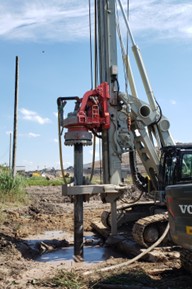
Significant Project Features:
- Shallow Soil Mixing to a maximum depth of 34 feet below ground surface.
- Stabilization of soft clay soils with Portland cement to facilitate future landfill development.
- Completion of the fifth stage (5 separate projects) of ground improvements performed on this site.
Project Background:
GSI completed the Stage 5 Ground Improvement project utilizing a Comacchio CH-650 track mounted drill rig fitted with a 9 ft. diameter, single flight auger. The Seneca Meadows Landfill resides on top of a soil strata primarily composed of a soft clay limiting their ability to expand across the site. This soft clay layer was the reason for the previous soil mixing projects completed at this facility for Stages 6, 7, and 8 which were completed by GSI between 2013 and 2017. For Stage 5, as with the previous stages, GSI mixed the soils with a Portland cement based grout to solidify the soft underlying clay soils. This method was selected for Stage 5 largely due to the success of the previous stages which demonstrated the ability of in-situ soil mixing to improve the low strength soil properties in a timely and cost effective manner.
Description of Work
- Installation and excavation of two test columns.
- Installation of 198 nine foot diameter soil mixed columns in 6 sub-zones.
- Maximum depth from ground surface of 34’.
- Soil mix zone ranged in height from 11’ to 28’.
- 253,071 cubic feet (cf) of soft clays were stabilized with 2,224 tons of Portland cement.
- Average UCS of stabilized clay was pver 300 psi after 28 days of curing.
- 20 of the columns were cored with a pitcher sampler, in addition to the two test columns, to provide a physical observation of the mixed soil.
- Work was completed over 15 weeks, including 3 weeks of production delay due to mechanical problems with the drill rig and 2 weeks of setup / teardown.
Key Project Objectives
- Cover >20% of the surface area with stabilized columns that extended above and below the known extents of the soft clay.
- Ensure that the strength of the composite treatment zones was greater than the required 1,000 psf design strength in sub zones 1 and 2, and greater than 1,500 psf design strength in zones 3,4,5, and 6.
Project Challenges
- Achieving a well-mixed soil-reagent composite in the soft, plastic clays.
- Availability of prepared work platform.
- Working on a sometimes unstable, variable work platform.
- Weather conditions affecting the work platform due to flooding and ponding of water.
- Using crane mats so the drill rig could gain access to the different mixing zones.
- Distance from batching plant to drill rig. Flow rates affected by distance and grout line diameter.
- Existing roadway and utilities bisecting the working area.
- Working around other contractors that were on site.